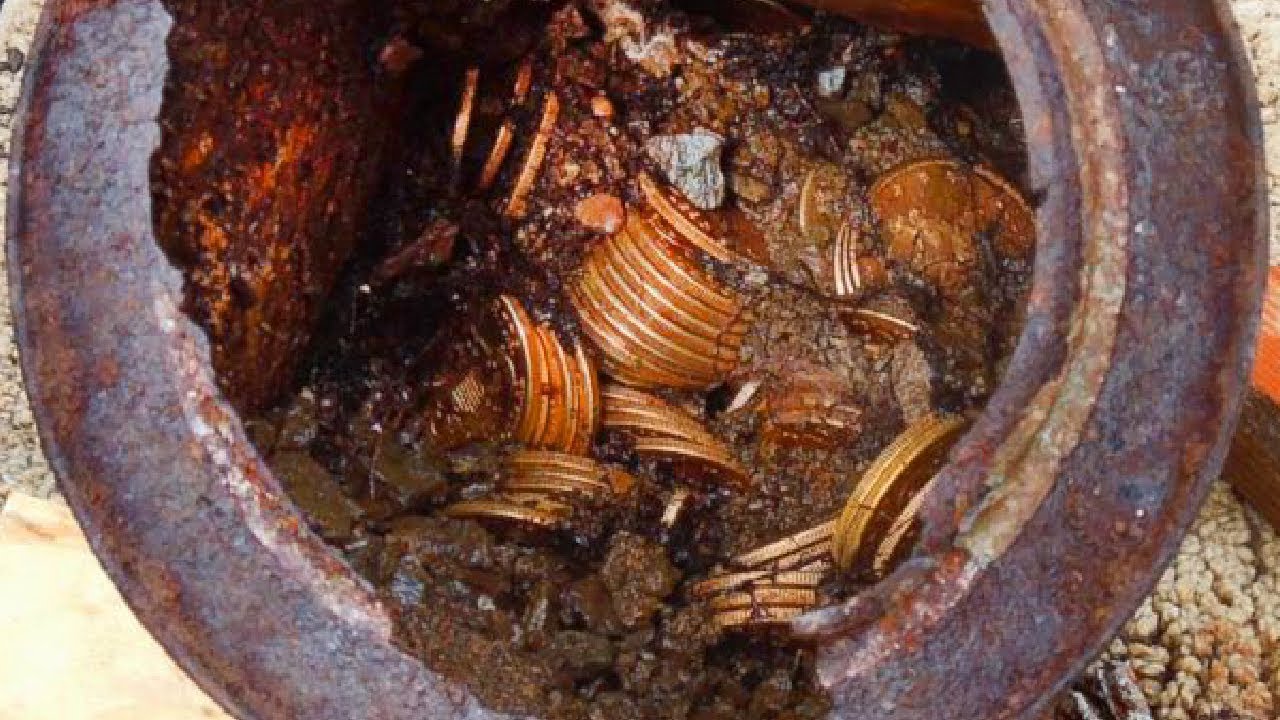
ACCIDENTAL Discoveries that made people RICH!! From children’s toys to household products…stay tuned to number 1 to find out who found $10 million dollars while hiking! These interesting artifact discoveries brought to you by Zero2Hero!! Don't forget to subscribe here! https://goo.gl/NXuChu Check out these Mysterious Underwater Cities DISCOVERED!!! https://youtu.be/OUwNmEiOiF8 Number 10: Play-Doh. Everyone should remember Play-Doh! Known by most as a fun childhood toy that you could use to make fun shapes and images, did you know that it wasn’t originally designed as a toy at all? Well, for nearly twenty-two years, the substance was used as a non-toxic wallpaper cleaner, and was first manufactured in Cincinnati, Ohio with the intent to help clean coal residue from household walls. Unfortunately, when residential homes changed from using coal to natural gases, much of the market for wall-paper cleaner was in decline. Thankfully, Joe McVicker, the nephew of Noah McVicker, who concocted the substance, noticed that children loved the play with the putty-like substance, and he quickly realized it’s potential as a toy for children. McVicker set about establishing Rainbow Crafts with the aim to promote the substance as a toy and, luckily for him, the idea quickly caught on! Within four years, McVicker managed to make somewhere around $3 million dollars in sales! Now, decades later, Play-Doh is still a fun toy, and used around the world! Number 9: Unopened 1948 Sports Cards. Filed in the category of, “oops, I forgot I had that…” a lucky Tennessee man found boxes upon boxes of sealed sports card packs in his 90-year-old aunt’s attic in Tennessee, after his uncle had passed away. This find included early 1960s Topps and Fleer football cards, as well as a rare, 1959 Fleer card of Ted Williams and many more! With a single box of 1948 Bowman cards being estimated at around $500,000 on its own, combined with the rest of the haul, the collection was thought to be worth well over $1 million! Not a bad result for clearing out the attic. I think I might need to look at mine! Number 8: Friction Matches. This next invention unfortunately didn’t make the inventor very rich, but paved the way for future manufacturers. Today, many smokers opt to use plastic lighters, and matches have become second-best to the convenience, and often refillable properties of lighters. But…long before lighters took over the market, matches were the most convenient way to create a flame quickly, and the person who accidentally discovered this amazing invention was John Walker. Born during the 18th century, Walker was searching for a quick and easy way to obtain fire. While Walker was preparing a lighting mixture, a stick that had been dipped in it set on fire when it accidentally had friction on the stone hearth next to him. And so…the match was born. But, unlike some of the other discoveries on this list, this one didn’t actually make its original inventor rich, at all…but it did allow him to live a comfortable life and retire early. It wasn’t until after his death that he received recognition for his discovery and other, more business-minded people adapted his idea and took over the market. Number 7: Petroleum Jelly – Vaseline. Today, petroleum jelly is most widely known by the name Vaseline and is used and sold across the globe. The first known reference to the product was when Robert Chesebrough invented a useful product from petroleum. The story goes that…in 1859, Chesebrough learned of a residue called ‘rod wax’ while visiting some oil fields in Pennsylvania where he saw that oil workers had been using the substance to heal cuts and burns. Seeing the potential, he took samples back home with him and eventually extracted the usable petroleum jelly and starting manufacturing Vaseline and marketing it as a medicinal product. During the 1870s he set up an office in London with subsidiaries in Spain and France, so it’s not surprising that by the late 1880s he was apparently selling the product to Americans at the rate of one jar per minute. Within 30 years he had factories across Europe, Canada, and Africa. The product continued to make him money until he died and the company continued to reap the rewards long after his death. It is said that in the years before the Chesebrough’s business was sold to Unilever in 1987, it was generating around $75 million dollars in profits. Number 6: Declaration of Independence. The Declaration of Independence is perhaps one of the most important documents in American history. But, strangely enough, it is a little-known fact that around 200 original copies were made at the same time as the original. Being of such importance to American history, though…you wouldn’t expect to find it anywhere other than in a museum or private collection. But, in 1989, a lucky collector managed to get a copy or just $4! Obviously, for that cost, we can assume that the seller didn’t know what they were selling.


Không có nhận xét nào:
Đăng nhận xét